
Following my earlier release of GPT-6 Astra’s work on the RICHI-170 encrypted German radio message from November 1918, I remembered that Astra also claimed that it has a “partial” result on another similar problem, RICHI-240, sent on November 11, 1918.
Here it is:
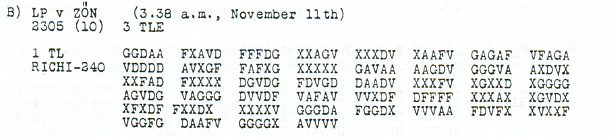
As with RICHI-170, this message was originally encrypted in the ADFGVX cipher by the Germans in November 1918. The keys to such messages are well-known, and hundreds of such messages have been successfully decrypted. But RICHI-240 - like RICHI 170 - was never previously successfully decrypted to my knowledge.
The key to RICHI-240 is well-known, and appears on the list of German ADFGVX keys from September - December 1918:

This should have made RICHI-240 easy to decipher (we have the message, we have the key), except that there was a problem with the message: the “240” in RICHI-240 means that the encrypted message originally had 240 characters. However, as is clear from the above screenshot, only 220 out of 240 characters have survived for whatever reason. Due to the incredibly complicated way in which ADFGVX ciphers worked (on which a bit of detail appears in my earlier post), the fact that these characters were missing - and, even more importantly, the fact that it is unclear where these characters ought to have been inserted - made RICHI-240 incredibly difficult to decipher.
To see why, let us try to use the same key to encode the opening lyrics from Weird Al’s classic hit “Amish Paradise”:
As I walk through the valley where I harvest my grain
I take a look at my wife and realize she’s very plain
But that’s just perfect for an Amish like me
You know, I shun fancy things like electricity
This verse, which consists of 199 characters, translates to the following using the above key:
AVVAA VGGDF AADDX DXDAD DADVV VXDXF GXDXA DDXVD DAADD DDADD
AAADD DDVDV FDFFX VDGVV VFGVG VDFDA XAXDA DVXAD ADVDV GADGA
XVDAF AXXGF XVXFX AVDAF VVDGV VVAAV AGAAV VVDAD FGXAD DGDVF
DDVXD XDAVV VFAAX AVGVF DVDVA DDGVV VXAAA FAAAV GGVDD VGFXX
XDADX XDDXF AGGFX ADFXF XDDVF FAFVA FAFVV DVVVD DVVXX VVGVD
XDAAV AXGDG ADVDV FGVAV DAXVX AFXFV DDDGF GGAVV DXGAV AGVAD
DDGFD DDDDD DDGA
As an experiment, let us try to remove “VXAAA FAAAV GGVDD VGFXX” (20 characters that appear at the end of row 4) from this message and then try to decode the message under the working assumption that a total of 20 missing characters would have appeared at the very end. This is the result, which is pure gibberish (with missing characters designated as question marks):
TII?ALNT2RO?-QUH2VA?-2GWWHR?--UR-ES?2I-R
TIN?KAIETDO?KITM-2I?N-ID1HA?D02S2HS?VI0P
M4I?-IUTQRT?JGKTP2R?1-4FI4A?WAKSE-I?EDWY
I4K?ODOSCRN?G-EY42I?D-MIK2E?141ROWI?2
This is why RICHI-240 remained unsolved: it was clear that 20 characters were missing from the message, but the message contained no clue regarding where these characters were omitted or what these characters were.
Enter GPT-6 Astra, which took the approach of trying several published keys on RICHI-240, assuming different possible arrangements of missing symbols. GPT-6 Astra scored the resulting blocks of text using patterns common in the German language. Relatively early on, this exposed a proposal that rendered coherent German text - i.e., inserting the 20 missing characters between the fourth and fifth lines of the message, which yielded:
?NXOXHXL?X11XARM?EXALPEN?ORPSRAU?XPETERR?VEXVERB?SZXX21??21?
X?XR?DXLINIE?NAGYBES??EREKXV??SECZXV??SECZXV??SERBEN??SETZTX
If you look closely at this text, you will see the following semi-recognizable bits:
11XARM?E - looks like “11th Army”
ALPEN?ORPS - looks like “Alpine corps”
SERBEN??SETZT - looks like the Serbs occupying some location
GPT-6 Astra then suggested characters that would imbue this phrase with meaning (while still sticking to the rules of the cipher): VFFXX DXXVV XDXDX GXXAF.
This yields:
AN O H L
11 ARMEE
ALPENKORPS RAUM PETERREVE VERBASZ
21? 21? ? RDD LINIE NAGYBESSKEREK VERSECZ
VERSECZ VON SERBEN BESETZT
Or, in English:
To Supreme Army Command. 11th Army: Alpine Corps in the Peterreve–Verbasz area. 21?th [through] 21?th divisions, and ?th Reserve Division on the Nagybecskerek–Versec line. Versec occupied by Serbs.
The three missing characters are numerical digits, and must be any of the following (each is unique): 5, 6, 7, 8, 9. Astra initially deemed its solution to be “partial” because there was no way it could independently verify from the key which digit went where.
But not to worry, Astra resolved the mystery using actual historical facts. A contemporary French intelligence telegram (sent by General Franchet d’Esperey to Clemenceau and Foch on November 19, 1918) describes the situation on November 11 and identifies the German 11th Army, the Alpine Corps, the 217th through 219th infantry divisions, and the 6th Reserve Division in the area:
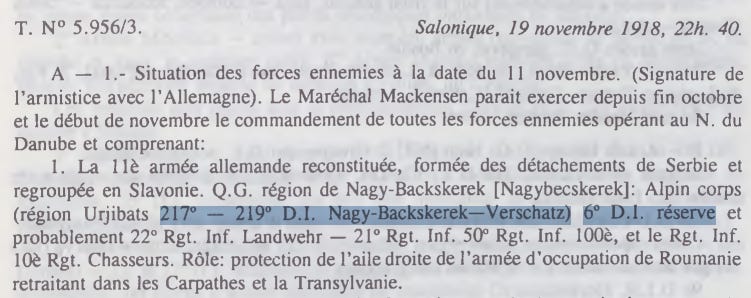
Inserting these three missing numerical digits (7, 9, 6 - which are all independent digits from the list 5, 6, 7, 8, 9) into the deciphered RICHI-240 yields the following final result:
AN O H L
11 ARMEE
ALPENKORPS RAUM PETERREVE VERBASZ
217 219 6RDD LINIE NAGYBESSKEREK VERSECZ
VERSECZ VON SERBEN BESETZT
And indeed, according to the official history of Vršac, the German army withdrew from the city on November 10, 1918, and the Serb units, led by Major Dušan Dodic, entered the city.

This occurred just hours before RICHI-240 was sent (3:38am on November 11, 1918).
I think Astra 6.0 will be going after WW II codes next🤷🏻♂️