
Updated December 1, 2025 - to include a clear explanation from Mark Chen on what OpenAI means by an “automated AI researcher” and an “automated AI research intern”.
Updated November 26, 2025 - to include new remarks by Lukasz Kaiser.
On October 29, 2025, Sam Altman and Jakub Pachocki announced during a livestream that OpenAI is building an “automated AI researcher”, targeted to be available by March 2028. Here’s what we know about it.
What’s Being Released and When
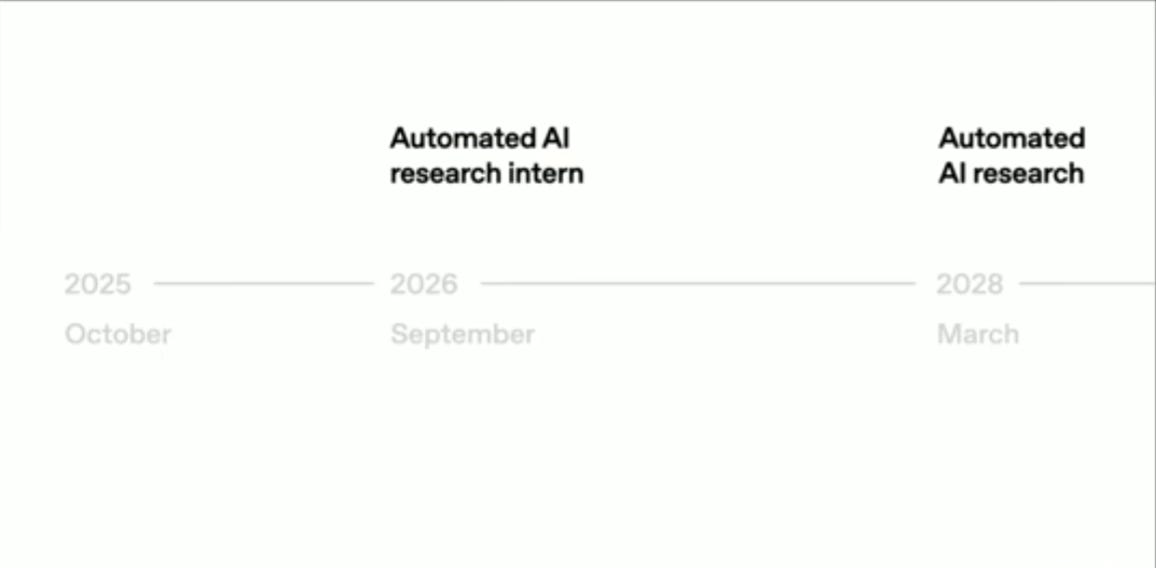
OpenAI’s goal is to “have”:
an automated AI research intern by September 2026
an automated AI researcher by March 2028
These appear to be dates by which OpenAI hopes to have these researchers available internally, and not necessarily release dates. For example, as tweeted by Sam:
We have set internal goals of having an automated AI research intern by September of 2026 running on hundreds of thousands of GPUs, and a true automated AI researcher by March of 2028.
Similarly, during the livestream, Jakub repeatedly referred to the goal of “getting” (as opposed to releasing) the research intern/researcher by these dates.
The Automated AI Research Intern
Even though OpenAI calls the model that will become available by September 2026 merely an “intern”, do not be fooled - this model will likely be very powerful. Sam wrote that the “intern” will run on hundreds of thousands of GPUs, a gigantic amount of compute. As a point of comparison, consider that OpenAI will likely have only just over 1 million GPUs online in total by year-end 2025. This means that running the “intern” alone would take up >20% (and possibly significantly more) of the entire compute capacity available to OpenAI today.
Given this background, it should not be surprising that, in Jakub’s words, OpenAI expects that the automated AI research intern will “meaningfully accelerate” its researchers.
The Automated AI Researcher
During the livestream, Jakub described the automated AI researcher as “a system capable of autonomously delivering on larger research projects”. Expect this system to be very impactful. In fact, Jakub described the automated AI researcher in a September 2025 interview as the focal point of OpenAI’s research program over the past few years:
Our set goal for our research program has been getting to an automated researcher for a couple years now. And so we’ve been building most our projects with this goal in mind.
Per Sam’s follow-up tweet, the automated AI researcher will have “extraordinary potential impacts” - potentially so significant that OpenAI has deemed it to be “in the public interest to be transparent” about its plans for developing it.
…But How Will It Work?
Update (December 1, 2025): Mark Chen has finally shed some light on what the automated AI researcher and automated AI research intern are intended to accomplish:
Within a year, we want to change the nature of the way that we’re doing research. We want to be productively relying on AI interns in the research development process. And within 2.5 years, we want AI to be doing end-to-end research. Today, you come up with an idea, you execute on it, you implement it, you debug it. Within a year, we’re quite confident we can get to a world where we control the outer loop - we come up with the ideas, but the model is in charge of the implementation and debugging.
So - the automated AI research intern will enable OpenAI’s research team to limit their work to generating new ML ideas; the intern will implement them and debug them. And the automated AI researcher will be doing “end-to-end research” - including generating new ML ideas.
Update (November 25, 2025): Lukasz Kaiser described the automated AI research intern similarly - i.e., as being able to convert clear - but general - instructions from a human researcher into an efficient implementation of the researcher’s idea:
Where AI researchers have great hope to help themselves... is that if you could just say ‘hey, Codex, this is the idea, and it’s fairly clear what I’m saying, please just implement it so it runs fast on this 8-machine setup or 100-machine setup’. I think that’s what OpenAI [means by] an AI intern by the end of next year.
As to how OpenAI intends to achieve this technically, Jakub Pachocki’s September 2025 interview may shed some light on at least some of the advances that OpenAI expects to power the automated AI researcher:
The big thing we are targeting with our research is producing an automated researcher. So, automating the discovery of new ideas, and in particular automating our own own work, automating ML research…
One good way to measure progress there is looking at the time horizon on which these models actually can reason and make progress. Now as we get to a level of near-mastery of high school competitions, we get to on the order of 1 to 5 hours of reasoning. We are focused on extending that horizon both in terms the models’ capability to plan over very long horizons and actually have ability to retain memory.
So, one piece of the puzzle may be to get the models to reason for longer - which OpenAI has been working on for a long time, probably since before o1-preview was first announced. Another may be to have the automated AI researcher “retain memory” (but it’s unclear how).
…And Will It Be AGI?
When asked “wen AGI?” during the livestream, Sam said that it’s more useful to have an automated AI researcher by March 2028 and define what that means that try to define “AGI”:
“The AGI term has become hugely overloaded, and… it will be this process over a number of years that we’re in the middle of. But one of the reasons we wanted to present what we did today is, I think it’s much more useful to say our intention, our goal, by March of 2028 is to have a true automated AI researcher and define what that means than to try to satisfy everyone with a definition of AGI.”
Greg Brockman recently said that he expects AGI to arrive within the next “one to three years” (for those counting, that means by late 2028) and that he “would feel like something went wrong if we were not there by 2030”. It’s interesting to observe how neatly the anticipated March 2028 release of the automated AI researcher falls within this timeline.