
Since early 2025, two leading frontier labs—OpenAI and Anthropic—have separately worked on accelerating the loop that they hope will eventually lead to recursive self-improvement (RSI), loosely defined as a process wherein an AI system is capable of building its successor fully autonomously, without any human input.
With OpenAI and Anthropic having significantly accelerated the cadence of their AI model releases (more on which below), the term “RSI” has become quite muddy and confusing. Elon Musk has said that RSI is already “happening to a large degree”, although it is “not yet fully automated”. OpenAI drew considerable attention in February when it described GPT-5.3-Codex as its “first model that was instrumental in creating itself”. Even a journalist, it seems, can already build a self-improving AI (“and so can you”)!
It’s no wonder that social media discussion of every frontier model release by Anthropic or OpenAI now looks like this:

So, what is RSI, really?
My favorite definition of RSI is this one used by Anthropic:
an AI system capable of fully autonomously designing and developing its own successor
Breaking this definition apart into sub-components, we get the feel for what RSI is and for what it isn’t:
“an AI system” - not just a model (i.e., use of a harness, such as Claude Code, is implied).
“capable of” - just because a model is “capable” of fully autonomously designing and developing its own successor doesn’t mean that it necessarily shall do so. For example, humans will likely be in the loop for safety purposes.
“fully autonomously” - without any human involvement whatsoever, including zero direction from humans regarding which research direction to pursue.1
“designing and developing” - the model would both come up with a detailed specification for how the next model should work and implement that specification.
“its own successor” - the point is not to be able to train a smaller model, or a specialized model in some other domain, or a fine-tuned version of the same model. AI Researcher 1.0 must be able to autonomously build a more capable AI Researcher 1.1.
The prinz addendum
Taken literally, the above definition implies that an automated researcher that, over the course of 6 months, develops a model 0.0001% more powerful than the researcher should qualify as “RSI”. But this cannot possibly be what the frontier labs mean by “RSI”! The point of a fully automated AI researcher is not merely that it would be able to conduct AI R&D without any human involvement; rather, the intention is that it would be superhuman at doing so.
Sam Altman lays out here exactly what OpenAI hopes to achieve with its fully automated AI researcher:
By March of 2028, we will have a full end-to-end, very talented researcher, like figuring out complete new architectures.
In other words, when provided sufficient compute, the fully automated AI researcher should have the requisite research taste to be able to make a significant and novel advance in the field of AI, and train the next model accordingly. And the next model - now significantly smarter and more powerful than the initial researcher - would be capable of discovering even more significant advances in AI R&D.
Modified to address the above considerations, the definition of “RSI” should read as follows:
an AI system capable of fully autonomously designing and developing its own significantly more capable successor, including by discovering and implementing novel architectures, algorithms, training methods or other technical advances
Where are we now?
I prefer to separate “the times of RSI” into three distinct eras:
1. “The age of research”
Reasoning models were all the rage, the coding harnesses were young, and you could be excused for thinking that Claude Code and Codex produced “slop” and AGI was still a decade away, or even that the AI bubble was about to burst.
I like to think that this era started with this tweet from Sam Altman:

It ended with the November 2025 release of Opus 4.5 and the December 2025 release of GPT-5.2, after which the acceleration became real.
2. The age of Mythoi
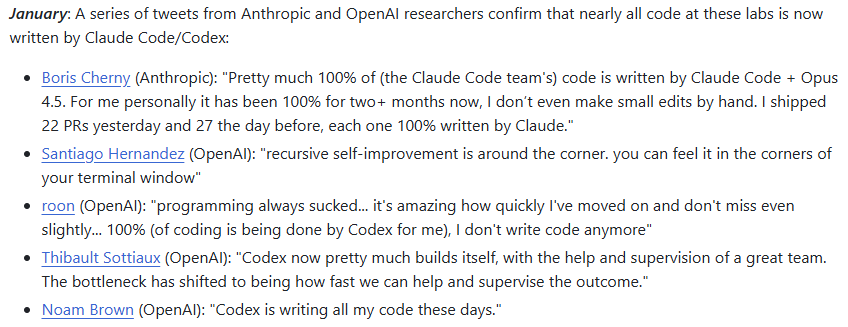
By January 2026, Anthropic and OpenAI researchers stopped writing code by hand:
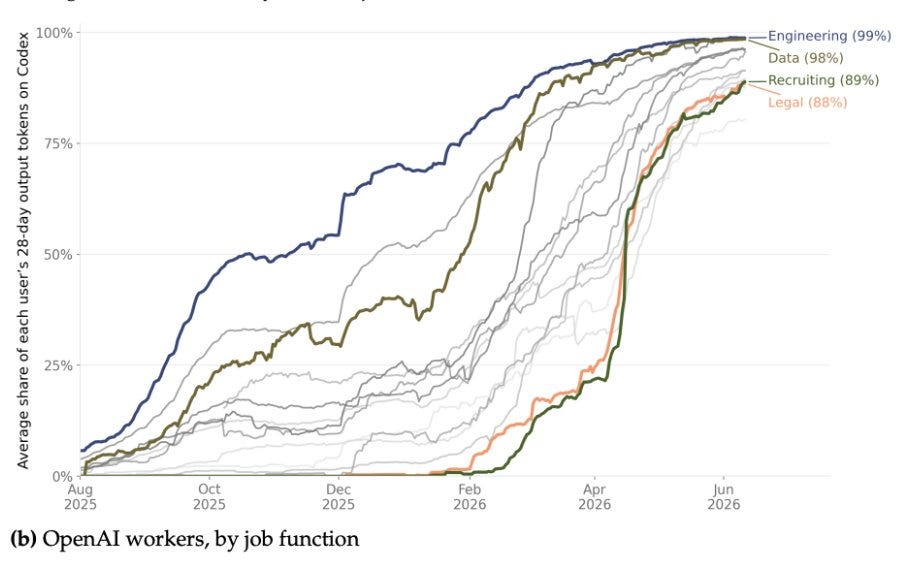
In Q1 2026, OpenAI engineers switched almost all of their work to Codex; other OpenAI followed in Q2 2026:
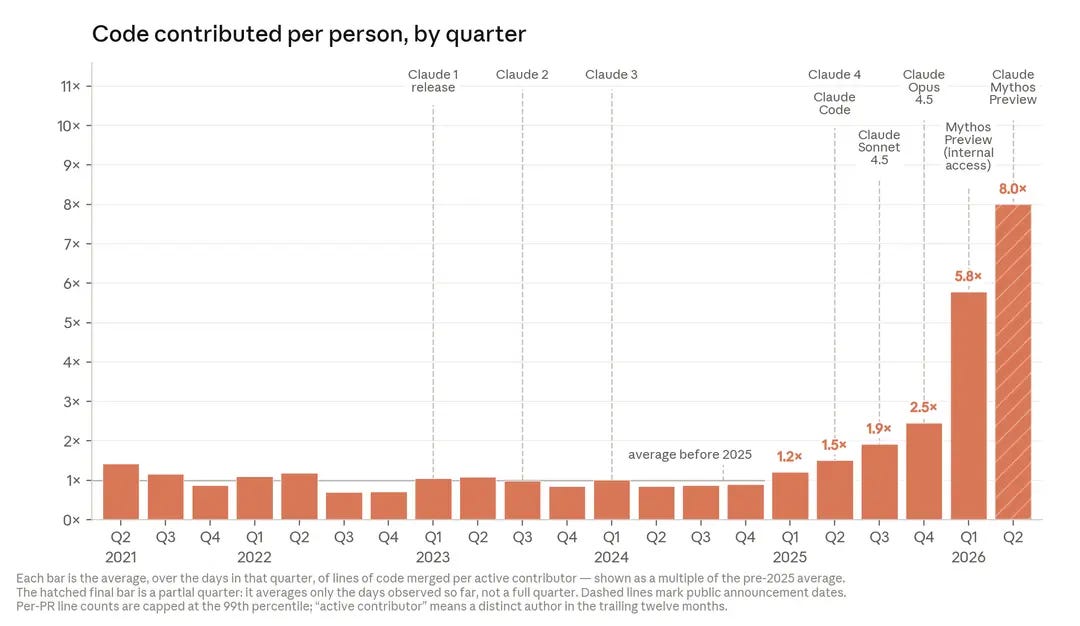
And with the internal release of Mythos Preview in late February 2026, Anthropic engineers were able to significantly increase the amount of code they produced:
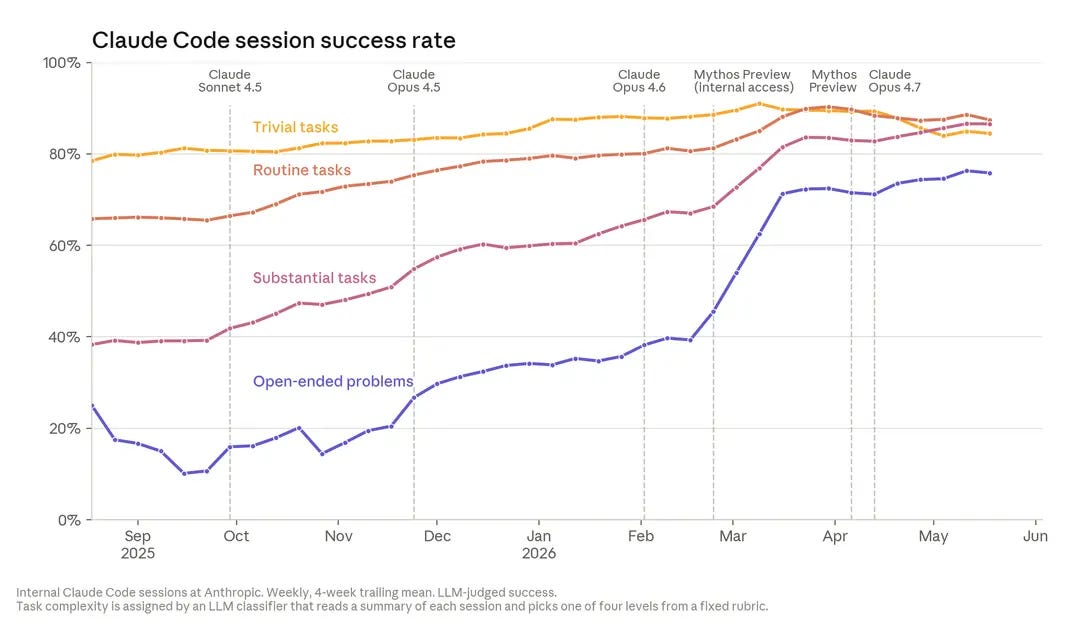
A few quarters into this age (you are here), we started hearing that Claude Code’s success on open-ended engineering tasks increased from ≈20% in December 2025 to 76% in May 2026…
…and that OpenAI’s models were capable of amazing feats, like GPT-5.6 Sol having autonomously post-trained GPT-5.6 Luna from a fairly simple prompt, which was described by OpenAI as “something that a team of senior researchers may have worked on”.
Very soon (by September), OpenAI should have a system capable of autonomously implementing specific technical ideas that might take a skilled human researcher “a few days” - a.k.a. the automated AI research “intern”,2 running on 500,000 A-100 equivalent GPUs.3
3. The age of fully autonomous AI R&D (and RSI?)
In June, writing about its progress towards RSI, Anthropic admitted: “[w]e are not there yet”. Why not?
In engineering, Claude can be handed an underspecified problem and figure out how to solve it; humans supply the goal, but they no longer need to supply the method. In research, Claude can already match or outperform skilled humans at executing a well-specified experiment. However, large performance gaps persist when it comes to Claude exercising judgement in choosing goals in both engineering and research. That’s the gap between AI today and a future system that could autonomously design its own successor…
An area of human comparative advantage, for now, is research taste and judgment, including choosing which problems matter, which results to trust, and when an approach is a dead end.
Similarly, at OpenAI:
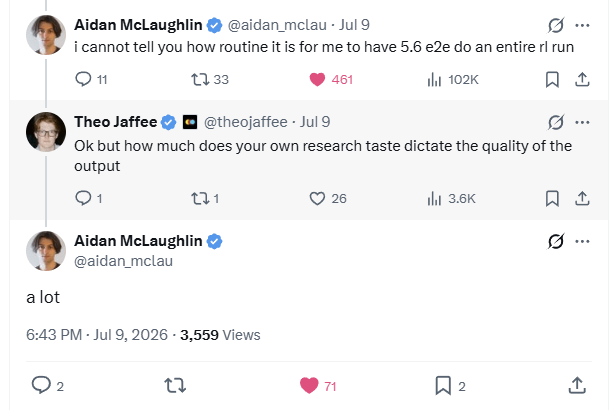
In other words, the age of fully automated AI research will commence when AI systems attain the research taste and judgment at least equivalent to those of the very best human AI researchers - imagine “a country of Ilya Sutskevers in a data center”.
When provided enough compute, the hope is that these AI systems will be able to “design and develop their own significantly more capable successors”. If RSI is technically feasible with current technology, it shall begin here.
When exactly shall we have RSI?
Publicly stated timelines differ - at times, significantly, and, at times, different senior leaders from the same lab have different timelines. Here is what has been publicly stated about when we might achieve RSI:
Possibly never:
Anthropic: “recursive self-improvement is not inevitable”;
Jack Clark: 40% chance based on publicly available evidence that no-human-involved AI R&D doesn’t work out because “we will have revealed some fundamental deficiency within the current technological paradigm”.
Early 2027:4
Anthropic: “plausible” that, as soon as early 2027, Anthropic's AI systems could fully automate, or otherwise dramatically accelerate, the work of large, top-tier teams of human researchers in domains including AI research.
Jared Kaplan: fully automated AI research could be “as little as one year away” from March 2026.
Year-end 2027:
Jack Clark: 30% chance based on publicly available evidence that no-human-involved AI R&D will be achieved on this timeline.
Dario Amodei: in January 2026, writes that we “may be only 1–2 years away from a point where the current generation of AI autonomously builds the next” - i.e., RSI will occur by some point in 2027.
March 2028:
OpenAI’s official goal for achieving the fully automated AI researcher.
Year-end 2028:
Jack Clark: 60% chance based on publicly available evidence that no-human-involved AI R&D will be achieved on this timeline.
The common trend among these predictions is clear: if RSI is possible with current technology, then it is very likely not much more than two years away.
Humans could, of course, still set a very general goal for the model. For example, the lab’s key priority might be to make the next model much smarter, or it could be to make the next model much more compute-efficient. Even a truly superintelligent AI researcher could benefit from being provided this very general goal.
GPT-5.6 Sol estimates that this is equivalent to ≈0.5GW of data center capacity.
In addition, according to a leaked OpenAI internal company memo from June 2026, OpenAI expected to launch its IPO "within the next year" (i.e., by June 2027), but "if advances in OpenAI's technology enable RSI (AI that can create new AI on its own), it could weaken the push for a quick IPO". This seems to suggest that OpenAI leadership views RSI as possible by year-end 2026 or early 2027.
I appreciate the rigor you have brought to this ambiguous topic. It seems to me that given the binding constraint of compute capacity in all of these future scenarios that somehow obtaining and utilizing said scarce resource might be incorporated into further iterations on this concept. Of course, that brings up the whole question of the interface between AI systems and the physical world which is a whole other question…
I think the labs believe RSI is similar to the "continuous learning" outlined in https://ai-2027.com. Doesn't seem to far fetched that a suite of algorithms could improve upon their own data and reasoning traces in an unguided way, much like how "self-play" led to emergent properties in OpenAI's https://openai.com/index/emergent-tool-use/ Might look like a combination of self-play from AlphaGo that updates a static model's weights in near realtime. Could be cool, I guess.